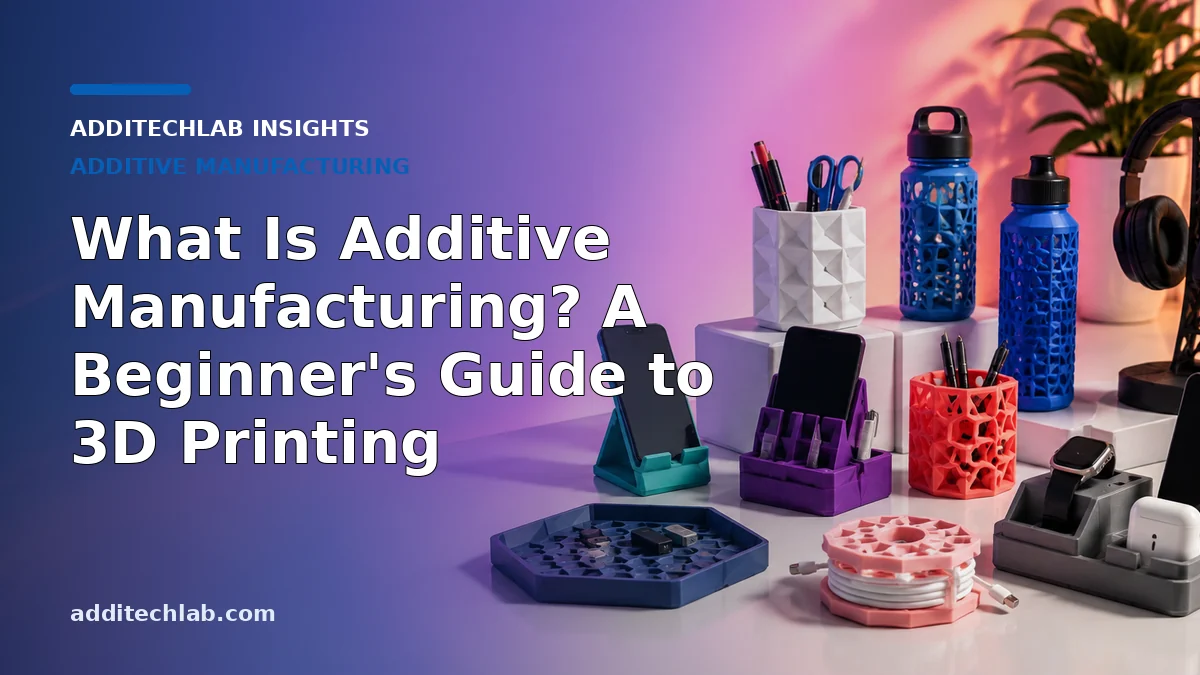
Additive manufacturing is transforming the way products are designed, developed, and manufactured. From simple household products and prototypes to complex engineering components, the technology allows physical objects to be created directly from digital designs.
Although the terms additive manufacturing and 3D printing are often used interchangeably, additive manufacturing represents a much broader approach to manufacturing.
In this beginner's guide, we explain what additive manufacturing is, how it works, some of the major 3D printing technologies available today, and why businesses and product designers are increasingly exploring it.
What Is Additive Manufacturing?
Additive manufacturing (AM) is a manufacturing process in which a physical object is created by adding material layer by layer based on a digital 3D model.
This is different from many traditional manufacturing processes.
For example, subtractive manufacturing typically starts with a block of material and removes material through processes such as cutting, drilling, turning, or milling until the desired shape is produced.
Additive manufacturing takes the opposite approach.
Instead of removing material, the machine places or forms material only where it is required to build the product.
This layer-by-layer approach makes it possible to manufacture complex shapes, customized products, prototypes, functional components, and low-volume products without always requiring expensive tooling or molds.
How Does Additive Manufacturing Work?
Although the exact manufacturing process varies depending on the technology being used, most additive manufacturing projects follow a similar digital-to-physical workflow.
1. Create the Digital Design
The process begins with a three-dimensional model of the product or component.
The model can be created using computer-aided design (CAD) software, developed from an existing design, or produced using other digital modelling techniques.
2. Prepare the File for Manufacturing
The digital model is exported into a suitable file format and prepared using specialized software.
The software divides—or slices—the digital model into many thin layers and generates the instructions that the 3D printer will follow.
3. Print the Object Layer by Layer
The 3D printer follows these instructions and gradually builds the physical object.
Depending on the technology, the machine may deposit melted thermoplastic, cure liquid resin, fuse powdered material, or use another additive manufacturing process.
4. Post-Processing
After printing, some parts may require additional processing.
This can include removing supports, cleaning, curing, sanding, polishing, painting, or other finishing operations depending on the technology and the intended application.
The result is a physical product created from a digital design.
Is Additive Manufacturing the Same as 3D Printing?
The terms are closely related, but they are not always exactly the same.
3D printing is commonly used to describe technologies that create objects layer by layer, particularly desktop and small-scale manufacturing systems.
Additive manufacturing is the broader industrial term covering multiple technologies, materials, equipment types, and manufacturing applications.
In everyday conversation, however, the terms are frequently used interchangeably.
Major Additive Manufacturing Technologies
There are several additive manufacturing technologies, each with different advantages, materials, costs, and applications.
Here are four technologies that are important to understand.
FDM — Fused Deposition Modeling
Fused Deposition Modeling (FDM), also commonly associated with Fused Filament Fabrication (FFF), is one of the most widely recognized forms of 3D printing.
The process uses thermoplastic filament that is heated and deposited through a nozzle. The printer follows the digital design and places the material layer by layer until the object is completed.
Common materials include PLA, PETG, ABS, TPU, and other thermoplastics.
FDM can be used for:
- Functional prototypes
- Product development models
- Home and lifestyle products
- Organizers and accessories
- Educational models
- Jigs and fixtures
- Custom enclosures
- Low-volume components
One of the major advantages of FDM is its accessibility and versatility. It can provide a cost-effective way to move from a digital idea to a physical product without investing in traditional tooling.
SLA — Stereolithography
Stereolithography (SLA) uses liquid photopolymer resin instead of thermoplastic filament.
During the printing process, light is used to selectively cure the liquid resin and form solid layers.
SLA is particularly useful when a product requires fine details, smooth surfaces, or high dimensional accuracy.
Typical applications include:
- Detailed prototypes
- Product presentation models
- Small intricate components
- Dental applications
- Jewelry patterns
- Engineering models
SLA parts normally require additional post-processing, including cleaning and curing after printing.
SLS — Selective Laser Sintering
Selective Laser Sintering (SLS) is an additive manufacturing technology that uses a laser to fuse powdered material, commonly polymer powders such as nylon.
Unlike many FDM processes, SLS does not generally require traditional support structures because the surrounding powder helps support the component during manufacturing.
This makes the technology particularly useful for complex geometries.
Common applications include:
- Functional prototypes
- Engineering components
- Complex assemblies
- Low-volume production
- Customized products
- Durable end-use parts
SLS is widely used in professional and industrial product development where performance and design flexibility are important.
MJF — Multi Jet Fusion
Multi Jet Fusion (MJF) is a powder-based additive manufacturing technology developed for producing strong, detailed, and functional components.
During the process, specialized agents are applied to a powder bed before thermal energy is used to fuse selected areas of material.
MJF can be particularly effective when producing multiple components efficiently and consistently.
Typical applications include:
- Functional prototypes
- Production components
- Engineering parts
- Custom products
- Low-to-medium-volume manufacturing
For businesses moving beyond prototyping toward production, technologies such as MJF can provide another path between traditional manufacturing and fully digital production.
Why Is Additive Manufacturing Important?
The value of additive manufacturing goes beyond simply being able to "3D print" an object.
It changes how products can be designed, tested, manufactured, and supplied.
Faster Product Development
A digital design can be converted into a physical prototype relatively quickly, allowing designers and businesses to evaluate ideas before committing to larger-scale manufacturing.
Design Freedom
Additive manufacturing can produce geometries that may be difficult, expensive, or sometimes impractical to manufacture using conventional processes.
Designers can therefore explore new shapes, internal structures, customized features, and product configurations.
Customization
Because manufacturing begins with a digital file, designs can often be modified without creating completely new tooling.
This makes additive manufacturing particularly attractive for personalized and customized products.
Reduced Tooling Requirements
Traditional manufacturing methods may require molds, dies, fixtures, or other dedicated tooling.
For certain applications, additive manufacturing can reduce or eliminate some of these upfront tooling requirements.
On-Demand Manufacturing
Instead of manufacturing large quantities of products and storing them in inventory, additive manufacturing can enable products to be manufactured when they are needed.
This creates opportunities for digital inventory, where some products or replacement parts can exist as digital files until there is demand for them.
Material Efficiency
Because additive manufacturing builds objects by adding material rather than cutting large amounts of material away, some processes can reduce material waste compared with certain subtractive manufacturing methods.
However, the overall environmental impact depends on factors such as the technology, material, energy consumption, product design, transportation, and end-of-life management.
What Can Be Made With Additive Manufacturing?
The possibilities extend across many industries and applications.
Additive manufacturing can be used to create everything from early-stage prototypes to finished products and industrial components.
Examples include:
- Home décor
- Organizers and everyday products
- Product prototypes
- Replacement components
- Manufacturing jigs and fixtures
- Custom enclosures
- Educational and STEM models
- Engineering components
- Architectural models
- Medical models
- Automotive components
- Aerospace components
- Customized consumer products
The appropriate technology depends on the product's size, geometry, material requirements, strength, surface finish, quantity, and intended use.
From Prototyping to Production
3D printing was once primarily associated with rapid prototyping.
Today, additive manufacturing has moved far beyond that role.
Companies can use the technology throughout the product development lifecycle—from early concepts and design validation to functional testing, manufacturing tools, customized products, replacement parts, and selected end-use applications.
This makes additive manufacturing particularly valuable for entrepreneurs, designers, engineers, manufacturers, researchers, and organizations looking for more flexible approaches to product development.
Choosing the Right 3D Printing Technology
There is no single additive manufacturing technology that is best for every project.
The right choice depends on several factors, including:
- Product application
- Required material
- Strength and durability
- Surface finish
- Dimensional accuracy
- Product size
- Geometry and complexity
- Production quantity
- Budget
- Lead time
For example, FDM may be an excellent choice for many prototypes, functional products, and cost-effective parts, while SLA may be preferred when very fine details and smooth surfaces are required.
SLS and MJF can provide additional options for more complex functional components and production applications.
Understanding these differences is an important first step when deciding how to manufacture a new product.
The Future of Manufacturing Is Increasingly Digital
Additive manufacturing connects digital design with physical production.
Instead of requiring every product to follow the traditional path of expensive tooling, large production quantities, and extensive inventory, additive manufacturing creates opportunities for faster experimentation, customization, distributed production, and on-demand manufacturing.
It does not replace every traditional manufacturing process. Instead, it provides another powerful set of manufacturing tools that businesses can use alongside conventional methods.
As materials, software, equipment, and manufacturing processes continue to advance, additive manufacturing is likely to play an increasingly important role in how products move from idea to design to physical reality.
Explore Additive Manufacturing With AddiTechLab
At AddiTechLab, we believe additive manufacturing can help bridge the gap between an idea and a physical product.
We use digital design and additive manufacturing to create modern products, develop custom 3D printed solutions, and help individuals and organizations explore new ways of bringing ideas to life.
Whether you already have a ready-to-print 3D model or need support developing your idea, we can help you explore the manufacturing approach that best fits your project.
Have an idea you would like to turn into a physical product?
